
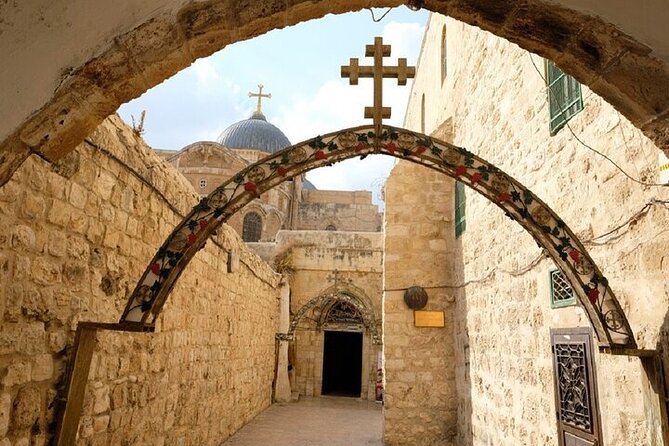
Reviewed · PETRA TOURS FROM ISRAEL
Jerusalem & Bethlehem Full-Day Tour from Amman or Dead Sea
One long day, two sacred cities.
This full-day trip from Amman or the Dead Sea strings together iconic viewpoints and the sites most tied to Christian pilgrimage, from the Mount of Olives skyline to Bethlehem’s Church of the Nativity and its underground birth grotto.
I especially like the private, air-conditioned vehicle with free Wi-Fi and mineral water onboard, because it makes a 11 to 12 hour day feel more doable. I also like that you get an English-speaking driver for the whole route, which helps you keep momentum when streets, crowds, and timing get complicated.
One thing to consider is that most major places don’t include admission, and border timing can affect your total cost. There’s also an optional local guide note for some stops, so if you want deep explanations in every church, you may want to budget extra.
In This Review
- Key points before you go
- Mount of Olives: a skyline viewpoint with major symbolism
- Temple Mount and Haram al-Sharif: shared holiness, real-world tension
- Church of the Holy Sepulchre: where the pilgrimage route lands
- Via Dolorosa: following the Stations without losing your place
- Tower of David: Herod’s fortress, plus Jerusalem’s story in museum form
- Mount Zion: Last Supper Room, David’s Tomb, and shared sacred spaces
- Old City of Jerusalem: gates, fortifications, and a ramparts walk for orientation
- Bethlehem: the Nativity grotto and Rachel’s Tomb in one visit
- Price and logistics: what $559.99 really buys you
- Should you book this Jerusalem and Bethlehem full-day trip?
- FAQ
- How long is the Jerusalem and Bethlehem full-day tour?
- What is included in the price?
- Are entrance tickets included?
- Is a guide included?
- What extra costs should I watch for at the border?
- What documents do I need to provide before traveling?
- Can I cancel or change the booking?
Key points before you go
- Mount of Olives panoramas and a quick look at key churches tied to Christian tradition
- Temple Mount (Haram al-Sharif) as a shared sacred space with major religious meaning for Jews and Muslims
- Church of the Holy Sepulchre as the spiritual end point of the Via Dolorosa pilgrimage route
- Via Dolorosa station route laid out for self-following, with a special Friday procession option
- Tower of David museum stop that explains how Jerusalem’s rulers, not King David, shaped the place
- Bethlehem visit time built around the Church of the Nativity and the Jewish holy site of Rachel’s Tomb
Mount of Olives: a skyline viewpoint with major symbolism
Mount of Olives is the sort of place where you look out at Jerusalem and instantly get why pilgrims come. The hill is heavy with churches, and it’s also home to one of the world’s oldest continuously used cemeteries. Even if you are not religious, the views across the Old City can do the heavy lifting.
The highlight up top is the Church of the Ascension, with a 1910 date and views that feel like you are standing above the city rather than just visiting it. Walking down the slope, you come to the Church of Pater Noster, built next to a tradition site where Jesus is said to have instructed his disciples.
A practical note for this stop: wear shoes that handle uneven stone and stairs. This is not the place for delicate footwear, and you will be walking more than you might expect for what looks like a straightforward viewpoint.
More Petra crossings from Israel:
- From Tel Aviv: Petra 1-Day Guided Tour with Transfers
★ 4.2 · 141 reviews - From Tel Aviv: Petra 2-Day Tour
★ 4.7 · 128 reviews - From Eilat, Jerusalem, Tel Aviv: Petra & Wadi Rum 3-Day Tour
★ 4.2 · 107 reviews
Temple Mount and Haram al-Sharif: shared holiness, real-world tension
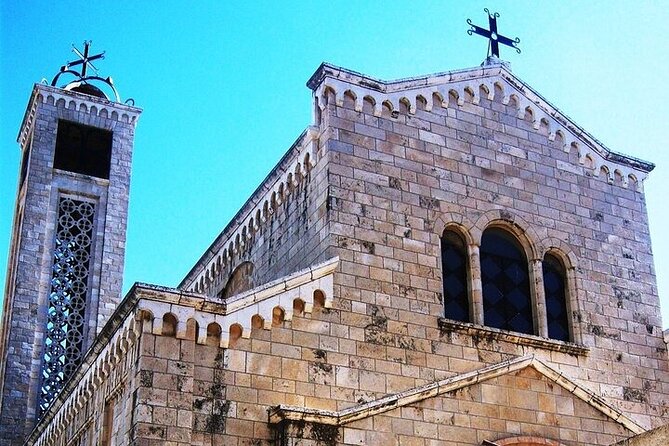
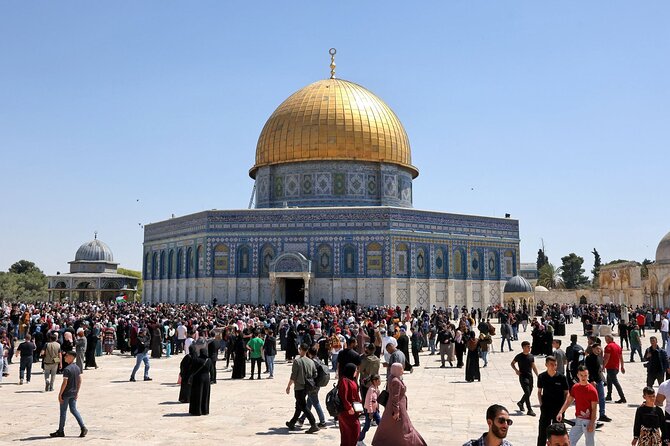
You then move to Temple Mount, also known as Haram al-Sharif, one of the holiest sanctuaries on Earth. What makes it fascinating is how many traditions attach to the same physical space. You’ll hear about Abraham offering his son up as a sacrifice, Solomon building the First Temple, and the tradition of Prophet Muhammad ascending to heaven.
At the center of the plaza is the Dome of the Rock, Jerusalem’s iconic landmark. Beneath it is the sacred stone that both Jews and Muslims believe is the place tied to Abraham’s offering tradition.
This is also a place with contention over ownership, so it is not a casual sightseeing stop. Go in with patience and the expectation that you are walking into a shared sacred site with complicated meaning. If you want a calm, personal moment, you might find the timing matters more here than anywhere else.
Admission is not included for this stop, so it is worth budgeting for tickets if you plan to go inside where permitted.
Church of the Holy Sepulchre: where the pilgrimage route lands
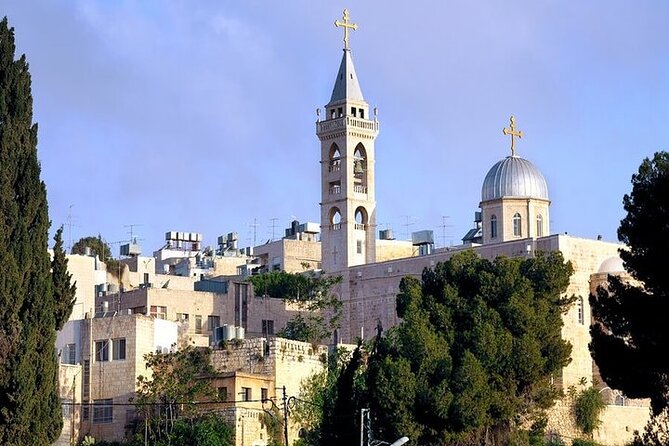
For Christian pilgrims, the Church of the Holy Sepulchre is the big one. It is said to be built on the site of Jesus’ crucifixion, and the church’s selection is traditionally linked to Saint Helena and Constantine the Great, who identified the Calvary (Golgotha) site after a Holy Land tour.
The church you see today is not the original. The earliest church dates to 335 CE, and it was destroyed in 1009. The grand church people visit now dates from the 11th century. That history matters because the building looks like an architectural timeline, not a single-era monument.
This stop also serves as the ending point for the Via Dolorosa pilgrimage. The last five Stations of the Cross are within the church, which is why the interior often feels crowded with devotion from all over the world. If you prefer open space and quiet, you may want to mentally switch gears here, because this is one of the most concentrated “religious landmarks per square meter” spots you’ll visit.
Admission is not included, so add that into your day math.
Via Dolorosa: following the Stations without losing your place
Next comes the Via Dolorosa, the Way of Sorrow route that follows Jesus’ path after condemnation, carrying the cross toward execution at Calvary. The route is marked by the fourteen Stations of the Cross. Some stations are based on the gospels, and some rest on tradition, which gives the walk a layered feel.
The tour’s route description is detailed enough that you can follow it independently:
- It begins on Via Dolorosa Street at the 1st station, east of the intersection with Al-Wad Street.
- You then follow the streets west, take Al-Wad Street south, and loop back toward Via Dolorosa Street west again.
- You continue through eight stations until the 9th station, which is at the Church of the Holy Sepulchre.
- The last five stations are inside the Holy Sepulchre itself.
If you’re here on a Friday, you can join a procession led by Italian Franciscan monks along this route. That is a special detail, and it is one reason the walk can feel different on different days.
My practical take: this is a walking segment in a busy religious area. Keep your schedule flexible, and keep your group close so you do not spend your time hunting for landmarks and people.
More day tours leaving Amman:
- 2-Day Tour: Petra, Wadi Rum, and Dead Sea from Amman
★ 5.0 · 1,141 reviews - 2-Day Petra, Wadi Rum and Dead Sea Tour from Amman
★ 5.0 · 467 reviews - 3-Day Private Tour from Amman: Petra, Wadi Rum, Dana, Aqaba, and Dead Sea
★ 5.0 · 425 reviews - From Amman: Petra, Wadi Rum and Dead Sea 3-Day Tour
★ 4.9 · 185 reviews
Tower of David: Herod’s fortress, plus Jerusalem’s story in museum form
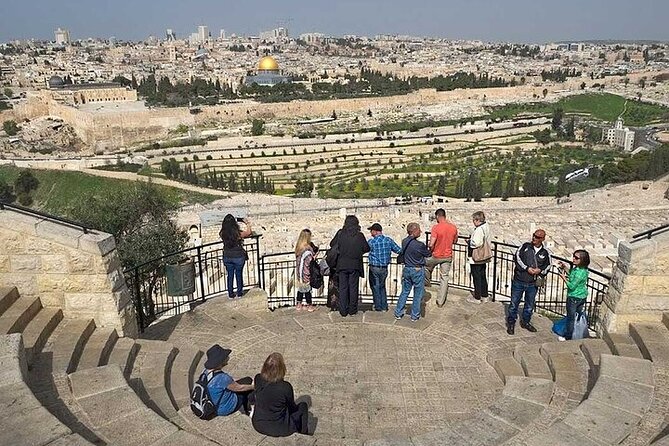
After the Old City churches and streets, Tower of David is a nice shift into a different kind of learning. It is called the Tower of David, but it actually has no connection with King David. The structure was erected by King Herod around 24 BCE to protect a palace he built.
The early citadel had three towers named after people tied to Herod’s world: Phasael, Mariamne, and Hippicus. Later, after Titus’ conquest in 70 CE, the Romans stationed a garrison there. Over time, the citadel fell into disrepair and was rebuilt by the Crusaders, Egypt’s Mamelukes, and the Ottomans.
The building you see now was built in the 14th century on the foundations of the original Phasael Tower. Inside, there is the Tower of David Museum, which relays the story of Jerusalem and includes permanent archaeological exhibits.
Time-wise, this is a short stop, only listed as about 5 minutes. So go in with a light touch: use it for orientation, a quick museum glance, and the chance to connect the city’s physical layers to the people who controlled it.
Mount Zion: Last Supper Room, David’s Tomb, and shared sacred spaces
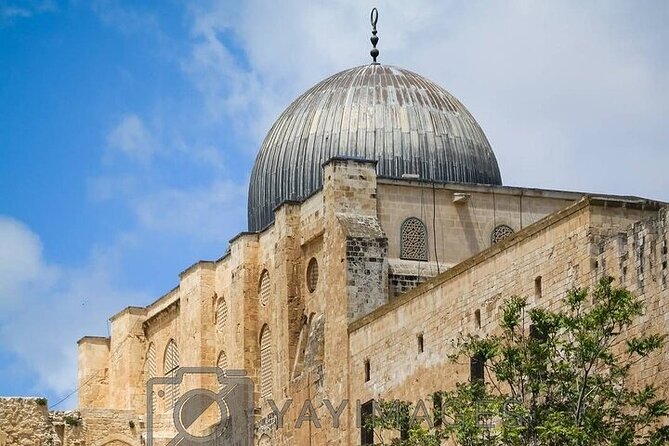
Mount Zion sits just south of the Old City’s Zion Gate, and it packs a surprising amount into a small area. It is home to Jewish and Muslim shrines as well as churches.
Christian traditions connect Mount Zion to the Last Supper, and to the belief that the Virgin Mary spent her last years here. You’ll also hear an alternative tradition that says her last days were spent in Ephesus in Turkey.
For Jewish visitors, Mount Zion’s importance centers on King David’s Tomb. If you climb the stairs from the tomb’s courtyard, you reach the Last Supper Room, a site that has served as both a church and a mosque over its long history.
Nearby is the Church of the Dormition, tied to the tradition of Mary’s death. To the east is the Church of St. Peter of Gallicantu, associated with the tradition that Peter denied Jesus.
This stop is less about one single moment and more about how many faiths interpret the same geography. If you like “context as you walk,” Mount Zion can be satisfying because it shows how layered religious meaning becomes over centuries.
Old City of Jerusalem: gates, fortifications, and a ramparts walk for orientation
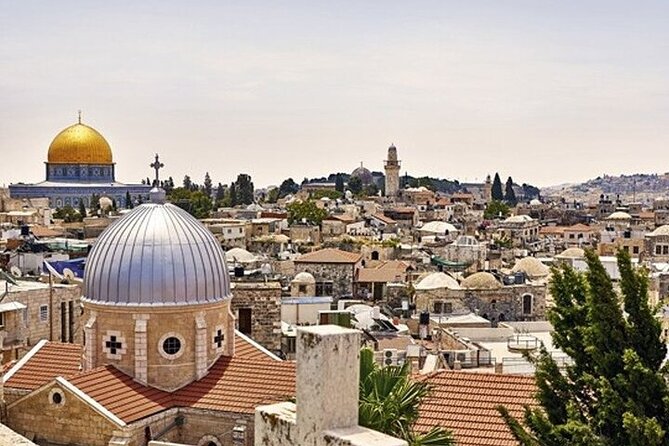
After churches and hilltops, you get time in the Old City of Jerusalem itself. The fortifications date from the Ottoman period, and nine magnificent gates lead into the walled area.
A few gates stand out in the story:
- Damascus Gate, one of the most famous
- Lion’s Gate, which leads toward the Mount of Olives outside the walls
- Zion Gate, the main entry into the Jewish Quarter
- Jaffa Gate, the main passageway for the Christian Quarter
One of the best ways to experience the Old City fast is to walk the ramparts. You get two possible rampart sections to choose from: from Jaffa Gate north to Lion’s Gate, or Jaffa Gate heading south to Dung Gate.
This matters because ramparts give you quick context. From the walls, you can get your bearings fast and understand why these neighborhoods developed where they did. It is also usually a relief from the street-level crush.
Bethlehem: the Nativity grotto and Rachel’s Tomb in one visit
Then you head to Bethlehem, in the West Bank, about 10 km south of Jerusalem. The name beit lechem means “House of Bread” in Hebrew, which is a nice cultural anchor as you arrive.
Bethlehem is most famous for Christian pilgrimage at the Church of the Nativity. During Christmas season, Christians from around the world visit to see the place where Jesus was born. What makes this site especially memorable is that the exact birth place is marked in an underground grotto.
You also get time for Rachel’s Tomb at Bethlehem’s northern entrance, an important Jewish holy site. The Old Testament ties Bethlehem to David, including that he was from Bethlehem and that he was crowned the first king of Israel.
The stop is about 2 hours, and admission for Bethlehem is listed as free. That helps the value side of the equation, since many other sites in this day can require paid entry.
Price and logistics: what $559.99 really buys you
At $559.99 per person, this is not a budget day trip. The value is in the structure: private transportation in a modern air-conditioned vehicle, an English-speaking driver, plus free Wi-Fi and mineral water onboard.
You do not get a dedicated guide included in the basic setup. Some local guides at certain sites may be available as options. That can be fine if you enjoy reading a bit on your own and you like the driver to handle navigation and timing. It can feel thin if you want detailed commentary inside every church and historical area.
Border timing is another factor in your final “real cost.” The tour notes a $49 charge for an extra hour or part of an hour after 60 free minutes of waiting at the border. So if your day runs long at the crossing, you could pay more than you planned.
There is also mention of permit-related needs, including sending a passport photocopy via WhatsApp so the provider can obtain a permit to enter Allenby Border Crossing. In practice, that means you should handle your documents immediately after booking to avoid scrambling on the day.
Finally, driver gratuities are highly recommended. That is common in private car tourism, but it is worth budgeting so it does not catch you by surprise.
Should you book this Jerusalem and Bethlehem full-day trip?
I’d book this if you want a single-day plan that hits the big religious highlights without having to coordinate transport between Jerusalem and Bethlehem yourself. The private vehicle helps a lot on a long day, and the combination of Mount of Olives viewpoints plus the Via Dolorosa ending at the Holy Sepulchre is a strong pairing.
I’d think twice if you want admission included, or if you expect a full-time licensed guide explaining every stop. Also, if you are very sensitive to border uncertainty, keep an eye on that waiting time rule and build in patience.
This tour is a solid choice for first-timers who want the main sights, but it will feel most satisfying if you go in with realistic expectations: you are walking through major sacred sites, not touring a quiet museum.
FAQ
How long is the Jerusalem and Bethlehem full-day tour?
It runs about 11 to 12 hours.
What is included in the price?
Included are private transportation in a modern air-conditioned vehicle, an English-speaking driver, and free Wi-Fi and mineral water on board the vehicle.
Are entrance tickets included?
No. Admission tickets are not included at the listed stops.
Is a guide included?
For the BASIC option, no guide is included. Optional local guides may be available at some sites.
What extra costs should I watch for at the border?
The tour notes a $49 charge for an extra hour or part of an hour after 60 free minutes of waiting at the border. Driver gratuities are also highly recommended.
What documents do I need to provide before traveling?
You’re asked to send a passport photocopy via WhatsApp to help obtain a permit to enter Allenby Border Crossing.
Can I cancel or change the booking?
No. The experience is non-refundable and cannot be changed for any reason.
Newest tours listed in Dead Sea
- Transfer From Dead Sea To Petra★ 5.0 · 4 reviews
- Amman Airport Pickup Or Drop off -To Or From Dead Sea★ 5.0 · 4 reviews
- Petra Day Tour from Dead Sea★ 5.0 · 6 reviews
- Spa Day at the Healthiest Point on Earth, Dead Sea Jordan★ 5.0 · 3 reviews
- Petra Private Transfer to or from Dead Sea★ 5.0 · 5 reviews
- Petra Excursion from Dead Sea★ 5.0 · 8 reviews
- Private One Day Petra from Dead Sea with Hotel Pickup★ 5.0 · 6 reviews
- Day tour to Jerash and Ajloun Castle★ 4.5 · 3 reviews
Petra Tours from Israel, compared.
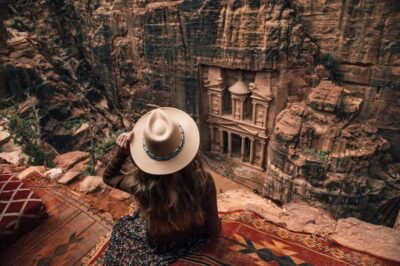
From Eilat, Jerusalem, Tel Aviv: Petra & Wadi Rum 3-Day Tour
Read our review →
Browse the lists this tour appears in